Why your journalism classroom looks different from all other classrooms in the building

Teaching & Advising Media

Desks – nope. Rows – nope. One dry-erase board with only the teacher’s handwriting on it – nope and nope.

Does this sound familiar? If it does, then you are probably a journalism teacher. If it makes you nervous just thinking about thirty students not quietly sitting in rows, taking notes down from the PowerPoint, then you are probably not a journalism teacher.

I have to admit, almost every day that I step into my classroom, I get the old sensation of my coaching days when I wasn’t sure what team was going to come out of the locker room. The most satisfying days in the gym were when I showed up and my captains led warm-ups, everything had been set up for the practice or game, and I was there to simply monitor and adjust. Those teams had won before the first play had been made.
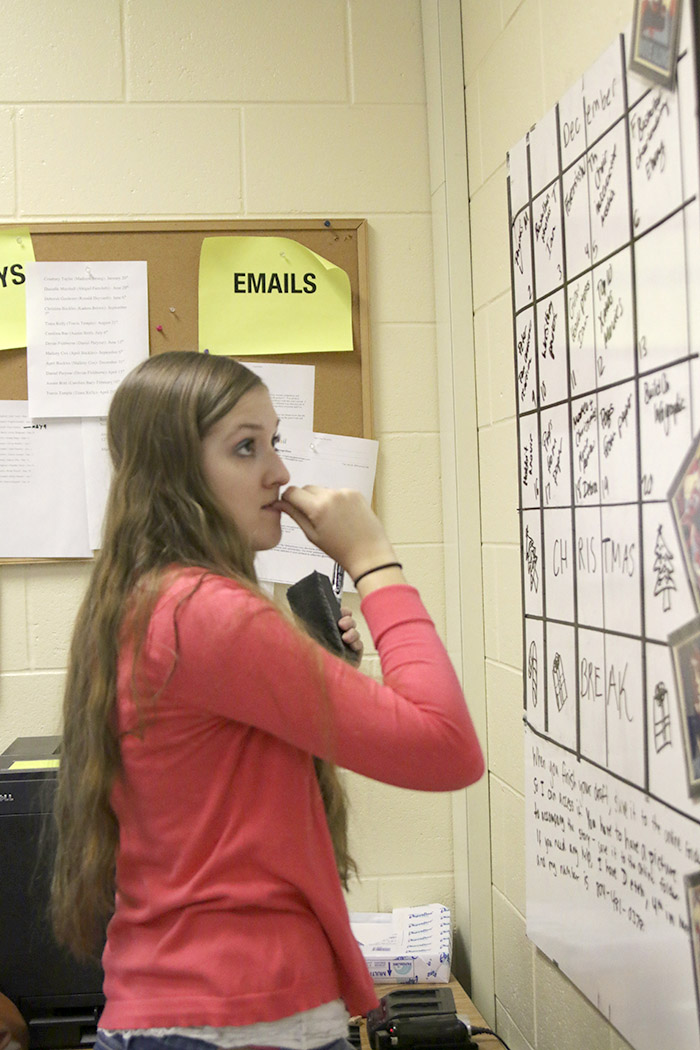
Editor-in-chief Lindsay Pugh looks over the online assignment board and calendar.

And this is how we should think about not only the media classroom, but all classrooms.

The media classroom serves many purposes. Of course one of the most important functions of that classroom is to provide a safe environment for students to learn how to write, interview, edit, and produce a product. Along the way the lessons that will be learned will be far reaching. There will even be those lessons learned to which students are somewhat oblivious. Here are some lessons that your classroom setup will teach your journalism students.

Lesson One: Listening takes a lot of work.

In our opening lessons on interviewing, I have my students do a number of things. The skill of interviewing involves much more than just jotting down a few facts. The lesson involves three students working together. One student asks the questions. One student responds to the questions. And one student records the audio of the interview and observes the interaction. Each role is essential in this activity.

The observer at the end of the experience shares what they saw with the entire class. Did the reporter give signals that they were listening? Did the reporter show signs of empathy through non-verbal communication? Did the reporter allow for there to be quiet time, or did the reporter interrupt out of being nervous?

In addition, the entire class listens to the interview and discusses the ebb and flow of the conversation. We discuss how it may have gone differently if this was said or that was asked.

The lessons they teach one another during these first weeks have such a huge impact on the way they interact as reporters on the job, and just as importantly as a staff when an editor is helping a writer. They cannot do this sitting in a row of desks. This activity and many other newsroom activities depend on an environment where students face one another. They need an environment where they can work together at one table.

So therefore there are no desks. And there are no rows.

Journalism students will spend more time working with each other than they will listening to me spout off about quote attribution. The work environment must reflect this need. There will be days when you think I wish they would all just get into rows and not make a peep. But this is not journalism. Will there be moments where they want to socialize? Yes. But that is when the coach in you calls a timeout, asks the captains to come over to the bench, and you tell them how they need to get the team refocused.

Lesson Two: I am not the only teacher in the room.

From the moment we first begin story idea brainstorming to the final page exported and sent to our local printer, students take the reins over every day. If there is not an opportunity for this, then make sure you make one. A publication’s room must be student-centered in project-based learning. The focus is on their passions in developing the learning experience.
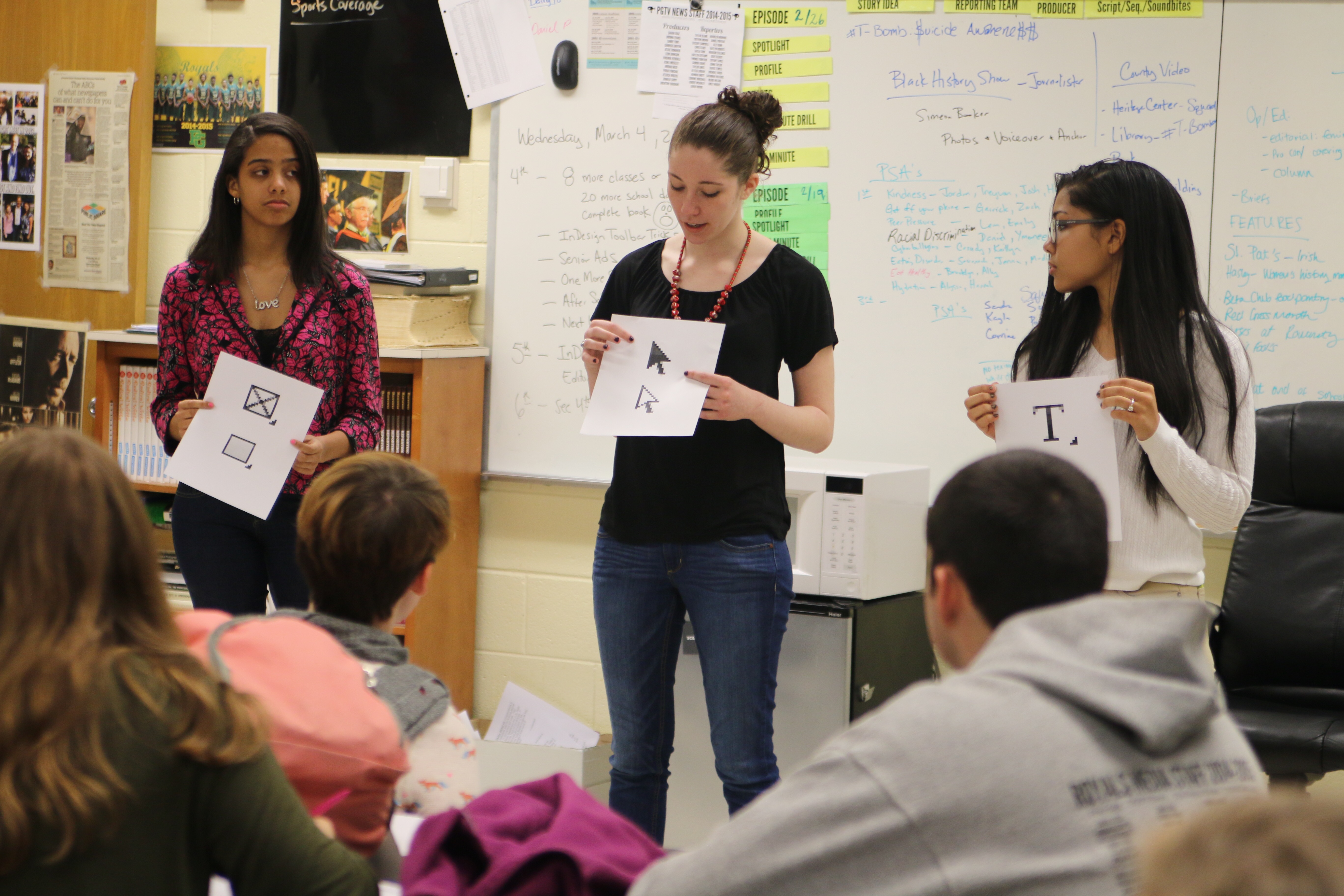
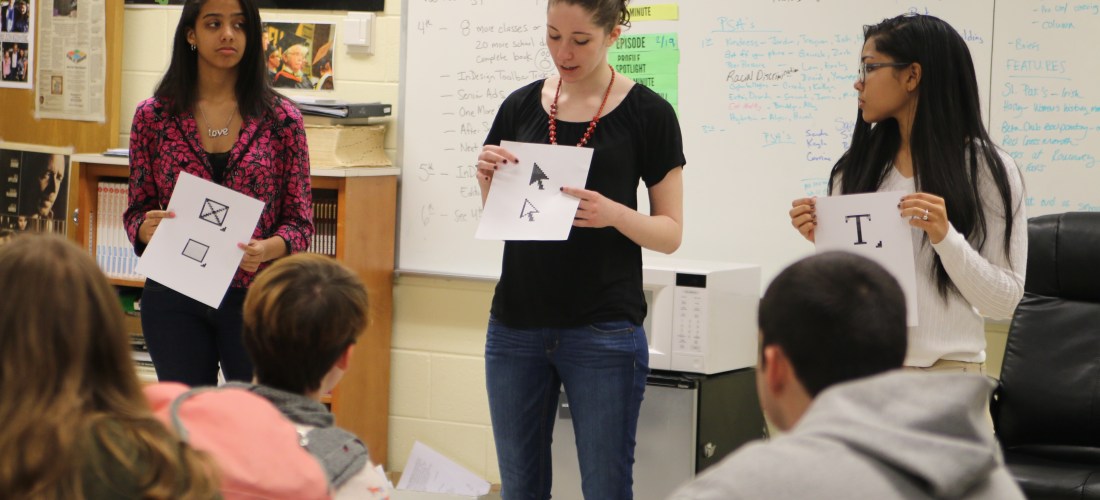
Editors Angela Martinez, April Buckles, and Ebony Gilchrist explain how the different tools on the InDesign toolbar work when using the program.

There are four speaking spots in our newsroom, and every time an editor speaks, they speak from their place of power. The online editor goes over the daily assignments in front of his/her deadline board. The newspaper EIC does the run down in front of his/her assignment board. The broadcast director does a check in front of his/her show board. The photo editors speak about assignments in front of the equipment lockers and calendars.

At the beginning of the school year or over the summer, take time to ask your staff what will work best for them. Combine those ideas with your expertise judgment and create a space that is conducive to collaborative work.

Every editor feels like they own the space they manage. If they feel like you are making the decisions and own the classroom, they will never completely take ownership of the publication. If they never take ownership of the publication, there will be times when apathy will run rampant in your newsroom.

Every classroom in our building where there are rows of desks, the students feel like they are just temporarily leasing that space. The students are there for 80 minutes to find out how to get a passing test score, and they will be on their way. In our newsroom, they come in early and stay late, because it is their home. Teachers should ask themselves: Would a student come in on his/her own to work if they didn’t have to? The answer to that question in the publication room is always a resounding yes.

Lesson Three: Assessment is different for project-based learning and student-centered learning.

Most of us have a recollection of a teacher passing back papers and wondering who among the class received the highest grade. I still remember a math teacher who would always praise this one particular student (we’ll call her Elizabeth) and the rest of us would resent her for busting the curve.

Obviously the goal in a classroom where testing is at the center is that the student should want to beat out the rest of his/her classmates. It is the age-old cliché of moving to the head of the class. And in some classrooms the presence of rows in fact invites such a mentality.

In a publication’s workroom there is only one goal for the staff and that is for all students to receive a 100/A on their final assignment. In my math class I would have never felt sad or responsible if Elizabeth missed a math problem on the test. In fact it probably meant I would be getting more of a curve. But on a newspaper staff, if Elizabeth misspells a word in the headline, not only do I feel bad for her, but I also feel responsible for not helping proof that page more. Not only did Elizabeth experience failure, but so did I and the rest of the team.

While each individual may be assessed for his or her knowledge and ability to complete a deadline, ultimately everyone is assessed when the public reads the paper or yearbook.

So my last bit of advice for your classroom, is to put on display your assessment. Enter contests, and hang your awards on the walls. Hold onto emails addressed to your staff about what a great job they did, and put them up on a bulletin board. If you have a bad issue talk about what needs to be done as a staff, and hang up a poster with three mistakes you’ll never see in another issue. Make your assessment known good or bad, so that they will work together to accomplish even greater heights.

No, your classroom does not look like the other rooms in your building. But eventually other teachers will find the strength to join you, and make the classroom much more than four walls and four rows.
Teach Your Staff To Take Yearbook Portraits

Camera Settings, Photography, Photojournalism

Let’s get one problem at a time out of the way this year. What problem do you think I am referring too?

Theme? Coverage? Content? Clubs?

No – I am referring to the one issue that more often than not affects our sales and that is the portrait section. If your photo is not in the people section why on Earth are you going to buy the book right?

So during my first week of school I had a plan. We are going to teach the entire student body how to take wonderful mugshots and have them submit them. Sound great.

Nope.

When I tried to get my own media staff to do this, they did not do so well. At this point, I decided we needed to take the portraits ourselves because under the COVID-19 guidelines outside vendors are not allowed into the building. Here is how we did it without a professional company and with student photographers.

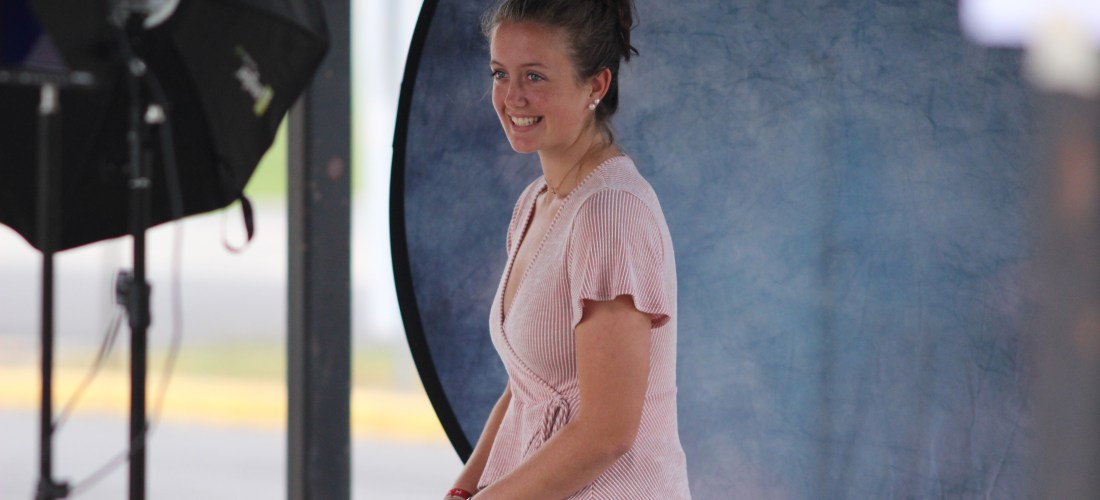
My first concern was for the safety of my staff and our students. I wanted to do it in a space that was safe for both our in-person kids and our virtual students. We decided to set up spots outside under our bus loop awning. Students would walk outside from their classes on Thursday, the in-person photo day, and drive up on Friday, the virtual day. I will explain how both went after I mention our equipment.

I needed to make sure that we had enough equipment (I am not endorsing any particular products – these just fit our needs). I ordered a few more Nifty 50 lenses so that I had four of the same kind of lenses. We used Canon cameras (see below for more specifics and cost).

Next, I wanted to have backdrops that would be easy to store once we were done and that were also affordable. We purchased four collapsible 5X5 backdrops that had blue/grey reversible sides. They attached with simple clips I bought from the hardware store on tripods that were light stands.

The last concern was consistent light. I already had a few speedlite external flashes, so I only had to get softboxes. However I also wanted to make them able to move away from the camera so I bought four remote triggers for the flashes. Trust me these will pay for themselves in the years to come.

I know this sounds like a lot of money, but I promise you if you have four cameras and four tripods that is most of the expense already taken care of.

On the week of the photo shoot, I took my classes outside to practice several times and we even made a video explaining to the rest of the school how it would be done.

Here is the link to the video: https://vimeo.com/461081634

On the day of the photoshoot, we had four stations with three people at each station: a photographer, a slate writer, and a photo assistant. In total we needed 12 people working the event.

Students approached the slate writer and told them their name. The slate writer wrote down their name and camera letter and gave them the sheet. The student sat down in front of the backdrop held up their slate for the first photo. They disposed of the slate into a box and took off their mask. The photographer told them to place both feet on an “x” marked on one side and took two photos. The photographer then told them to put their feet on the “x” marked on the other side and took two more photos.

The assistant made sure that the backdrop stayed steady and that the flash was firing.

We saved all of the photos from the four SD cards on an external hard drive. We then went through the eight folders, four for in person students, four for virtual students, and used Adobe Bridge and Photoshop to rename them and crop them. We then uploaded them to EDesign and SmugMug. Our parents will be able to search on our SmugMug account to purchase them and they are kept private with the use of their student ID number as their password.

That’s it. I thought I always wanted to try this and this is the year that if it fails who cares?

Here are the payoffs. Your kids are shooting the portraits. Your kids are shooting the portraits. Your kids are shooting the portraits.

Before this has always been the section that the staff was only marginally proud of. Now they can’t wait to see it all together.

When we asked our staff how they felt it went, they said they think that our students were much happier because they knew we cared about them having a good photo. Usually the professional company has to rush them through, and the students didn’t feel that with our staff photographers there.

I learned a couple of other things. A rainy day, as long as it doesn’t get your equipment wet, is a great external lighting day. And portrait photography is one of the best ways to get a shy photographer to come out of her shell. The student cannot do this job if she does not speak to the subject.

The payoffs were immense. The stress was good. The students felt very proud.

Here is a list of equipment and costs for one setup.

Required:

Backdrop: Kate 5X5 Collapsable Backdrop ($89)

Stand: Impact Light Stand 6’ ($19.99)

Only Other Things Required But You Probably Have:

Camera: Canon T7  ($449) – We used our old T5i and 70D cameras

Lens: Canon EF 50 mm F1.8  ($125) Yongnuo YN50mm F1.8 ($59) – Yongnuo worked fine.

Camera Tripod: This doesn’t really matter but you need a tripod. You can use a $29 or a $290.

Things That Would Be Nice To Have:

Light: Yongnuo Speedlite YN600EX-RT II for Canon Cameras ($138)

Softbox: Angler BoomBox for Shoe-Mount Flashes 26″ ($59)

Remote Flash: Vello FreeWave Mini-Stand Flash Trigger Set ($24.95)

Mobile White Studio for Silhouetting Portraits

Photojournalism

Wow now that is a fancy title for this simple process. This something that we have come up with for making the silhouetting process easier on our first-year photojournalism students.

Screen Shot 2015-02-11 at 7.40.13 PMThe purpose of this little adventure was to be able to have our staff of 20 new photojournalism students (with limited photography skill/experience and limited Photoshop skill/experience) be able to create a spread in our student section of silhouetted portraits.

Before we started this adventure we had to identify the potential road-blocks.

Everyone wants to have a beautiful white studio to be able to take well-lit portraits. However, in most cases very few staffs have the money for the equipment, nor do they have the space to set it up.

Also, students have a difficult enough time pulling students aside to do interviews. We knew that to get photographers to bring the student or staff to the yearbook room would add even more variables to the problem.

Lastly we knew that the students were not experts in using the eraser tool in Photoshop, so we would have to make the background of the photographs as solid as possible.

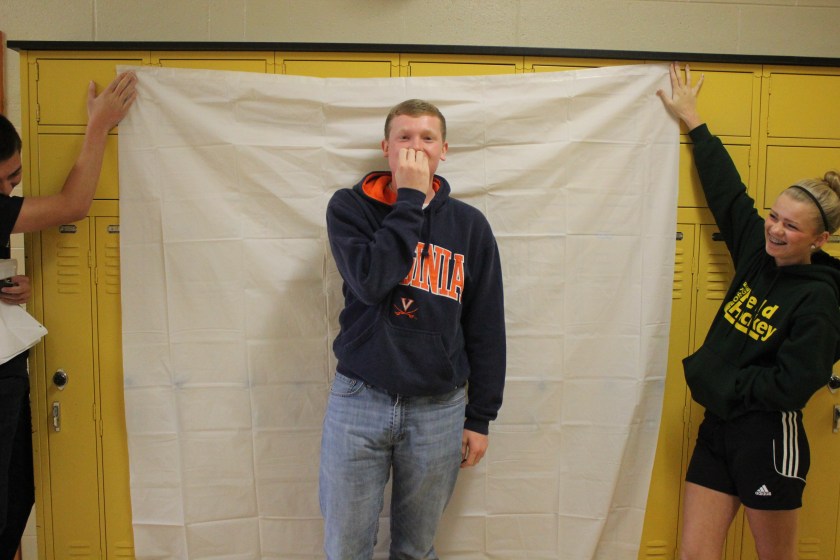
Solution: white shower curtain $1.99 at your local retail store.

Students grabbed a curtain and some magnets (which some curtains have magnets built in) and a camera and placed the shower curtain on the metal lockers. They quickly snapped a few photos and then were on their way. They downloaded the photos to Photoshop and in most cases used the magic eraser to knock out the white background. This provided them with a transparent field behind their subject. They saved the photo as a .png file and placed the photo in the spread.

My Message Five Years Ago Still Rings True

Uncategorized

Five years ago I entered a contest by answering one simple question… Why is journalism education is important? I thought the answer was so obvious, but I think today it is just as important as ever to say it again. Here is what I wrote:

“The purpose of education is to make our young citizens better people. So how do we do that? We teach them to be empathetic. We teach them to listen to others. We teach them to understand how to communicate with each other. We teach them to be ethical in their actions. We teach them to consider both sides of an argument. We teach them to adapt to the changing world around them. We teach them to view the world through a different lens. We teach them… journalism.”

As another school year begins, I focus on these words again. Good luck teachers on another successful year of endeavors.

Link: http://www.adweek.com/fishbowlny/why-journalism-education-is-important-contest-winner/241485

First Yearbook Distribution

Uncategorized

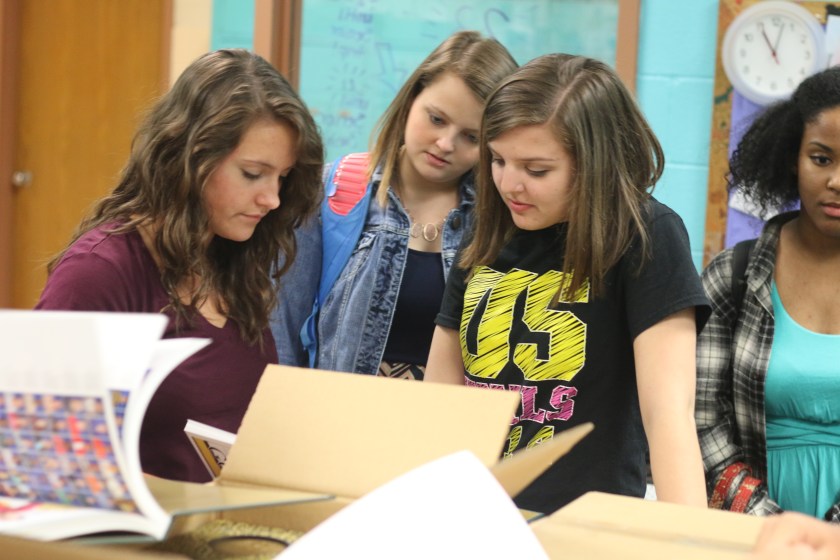
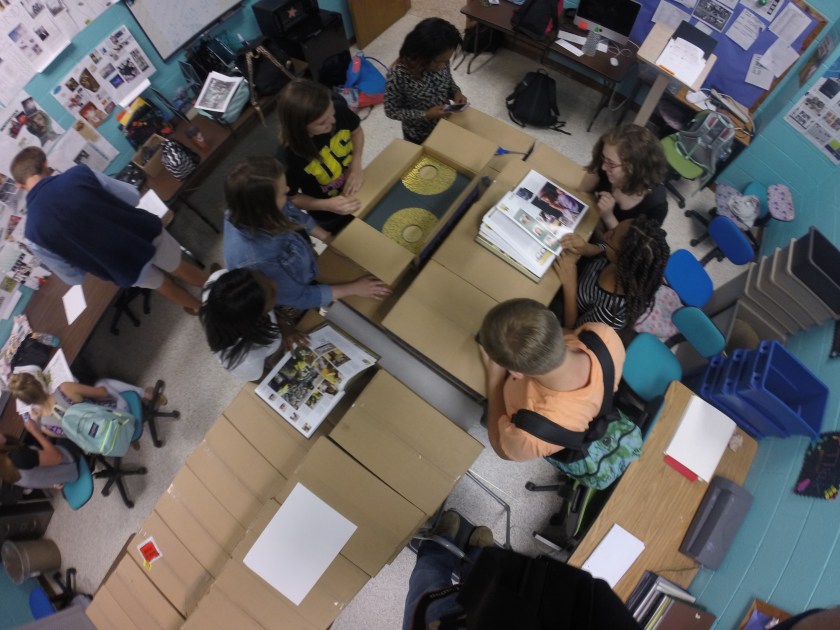
IMG_8246So it all comes down to this… 600 books in 50 boxes on two pallets to be viewed by an entire community. To tell you the truth, throughout this first year of advising the yearbook I tried not to actually think about this time of year for the most part. This is due to the fact that I am an extremely superstitious person, and I never want to jinx any outcome, especially the delivery of such a huge collective effort.

To be perfectly honest, although I hoped for the best, I expected the worst. There were just too many factors this year that were going against us: 90% new staff, majority of members were 10th graders, and then the snow. But I had to believe that our hard work would pay off in some way.

Day One – The Arrival – Thursday, May 14, 4:30 PM

I don’t remember much about this day now to tell you the truth – it seems so long ago, so I will just list some of the pluses and minus.

Positives: It wasn’t raining. All the books arrived on time. I had two people help transport them to the yearbook room. And later I had the full staff available to take them to the staging area.

Negatives: It was long after the staff had gone home. There was no overwhelming energy of taking books off of the truck and I had to wait 24 hours to open up a box.

Day Two: The Big Reveal – Friday, May 15th, 11:00 AM

I will have to say – it felt great. And I think the kids felt great. Relieved. Accomplished. Excited. Proud. I honestly think that just as long as there was a green cover in that box and pages that had words on them, then we would have been happy. This feeling made it all worth it. And I was happy.

The next feeling was different. It was a feeling that I had felt before, but not to this extent. Sure we were always leery of mistakes in newspaper, online, literary magazine, and in broadcast, but this feeling was different.

Day 9 – Senior Distribution Day – May 22, 10:15 AM

The feeling was worry. What did we miss? What did we misspell? What is going to make us look completely incompetent? What will make me want to run and hide, give back my undergraduate and graduate degrees in English and Mass Comm? It was a feeling that I hadn’t felt since William and Mary. Those professors can put the fear of God into you, especially if you had not done the reading the night before.

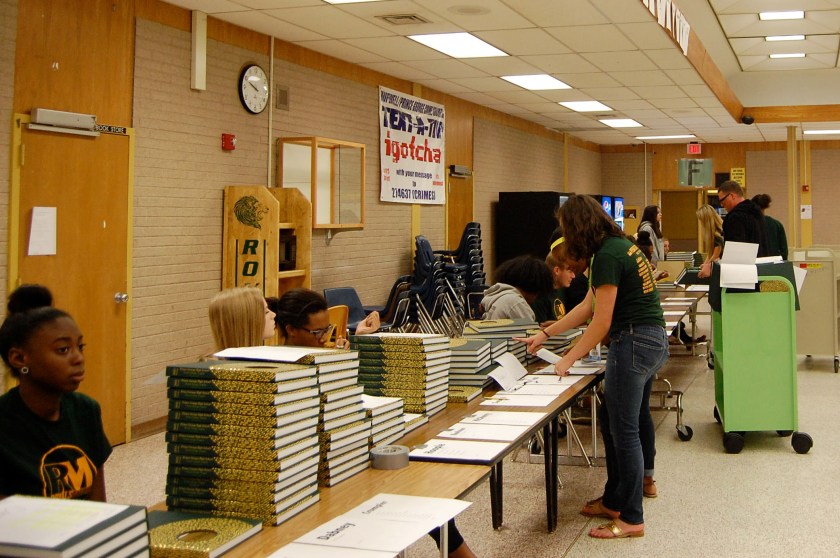
Seniors were called to the commons at 10:15 AM. Students were staged behind tables with three classes of seniors books – on average 10-15 books to handout. Students lined up at each end and were directed to the table which had a sign clearly marking their fifth period class. Seniors showed a photo ID, signed the sheet, and then walked to the middle of the tables and exited back into the commons to sign one another’s books.

The distribution went pretty well, with the exception of a slight altercation (non-yearbook related) that required the forced removal of two students by adults. But hey besides the fight, everything was going well.

Then around 1:00 PM – the craziness of handing out yearbooks subsided and the guttural fear of errors came back. I then remembered what Obi-Wan said when the Death Star had just blown up the planet of Alderaan…

I spoke with two parents about two misspellings and it was miserable. I know what you are saying, “Dude, it is not that bad.” But then every time a student said, “Mr. Waugaman did you see page such and such,” the feeling grew. Now I am not saying that this happened a lot, but the mentioning of even five pages with mistakes feels like this…

And after the weekend things got better. Of course then the underclassmen received their books and another waive of did you see page… came through.

So here we are… two weeks later after the roller coaster has stopped. I cannot tell you how much these last two weeks have prepared me for year number two. Some life lessons:

1. Have seniors sign off on proofs of senior ads.

2. Stress having students proof pages without distractions. Easier said than done. And the more eyes on a page the better. Show them examples from your book of where not being focused may have caused an error.

Screen Shot 2015-05-19 at 8.59.15 PM3. It was a great idea to have seniors sign off on the people section of the yearbook. So far zero errors there (I just jinxed myself I am sure).

4. Embrace the pain of discovering errors and use it to help next time. Remind yourself “it is scholastic journalism,” even if no one else believes it.

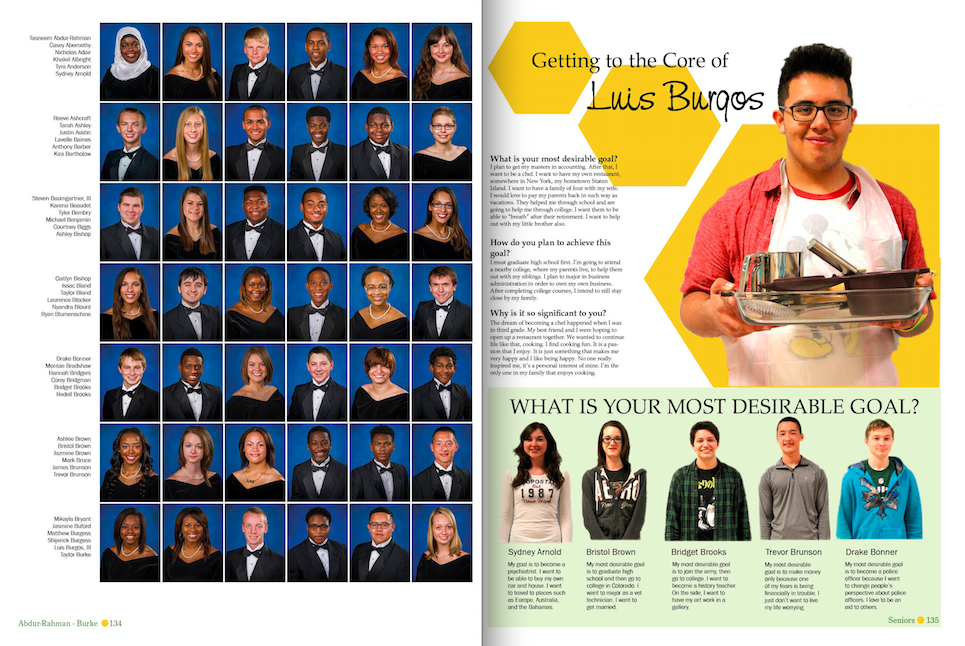
5. I did not realize that the jr., sr., II are used in a variety of ways when a child is taking an exact name. And then there are many other rules too once you have deaths in the family. Get it in writing, before you make the mistake. We used a II instead of a III.

6. When handing out yearbooks, be absolutely sure that there is not a personalized book somewhere before handing the student one with no name on the cover. It is however a good way to get a couple of cut-up books.

7. Start identifying where students will be during distribution (we used 5th period) once they start to buy their books, and keep up with these lists, rather than trying to create lists once the books arrive.

8. Set up a schedule for when you will be available for book distribution for times other than the period you originally dedicate. We had a number of field trips this past week.

9. Keep in your mind that these five days are just that. Five days. The excitement will wear off and things will get back to the normal craziness of making next year’s book.

10. There is always next year. Unless you are a senior and then it’s over!

I am sure I will look back at these two weeks and forget all of the pain and only remember the joy. This year has been a lot of fun and now… it’s on to spring packets, graduation coverage, senior portraits…